


It often starts in a simple moment. You reach into a cabinet and notice the movement does not feel smooth anymore. You go to put on a shirt or jacket and the shoulder feels awkward, tight, or weak. Washing your hair, reaching behind your back, or lifting something overhead suddenly feels more difficult than it used to.
A lot of people describe all of that as “shoulder pain,” but what they are often noticing first is not just pain. It is a loss of function.
 And that matters.
Trouble lifting your arm can mean several different things. Major orthopedic sources describe limited shoulder motion as a symptom that can show up with rotator cuff problems, bursitis, impingement, frozen shoulder, arthritis, instability, and sometimes even issues outside the shoulder itself, including the neck.
At Innerve8 Medical, that is where the conversation starts. The shoulder may be where you feel the problem, but the real pattern is not always limited to the shoulder alone.
What limited shoulder motion may mean
One of the most common reasons people struggle to lift the arm is rotator cuff-related pain. That does not always mean a full tear. It can also mean irritation, tendinitis, bursitis, or impingement. In these cases, people often notice pain with lifting, reaching, or lowering the arm, weakness with rotation or overhead movement, and discomfort that may get worse at night. AAOS notes that shoulder impingement and rotator cuff tendinitis commonly cause pain with lifting and reaching, and Mayo Clinic notes that rotator cuff problems can make it difficult to comb your hair or reach behind your back.
But not every painful or limited shoulder is a rotator cuff problem.
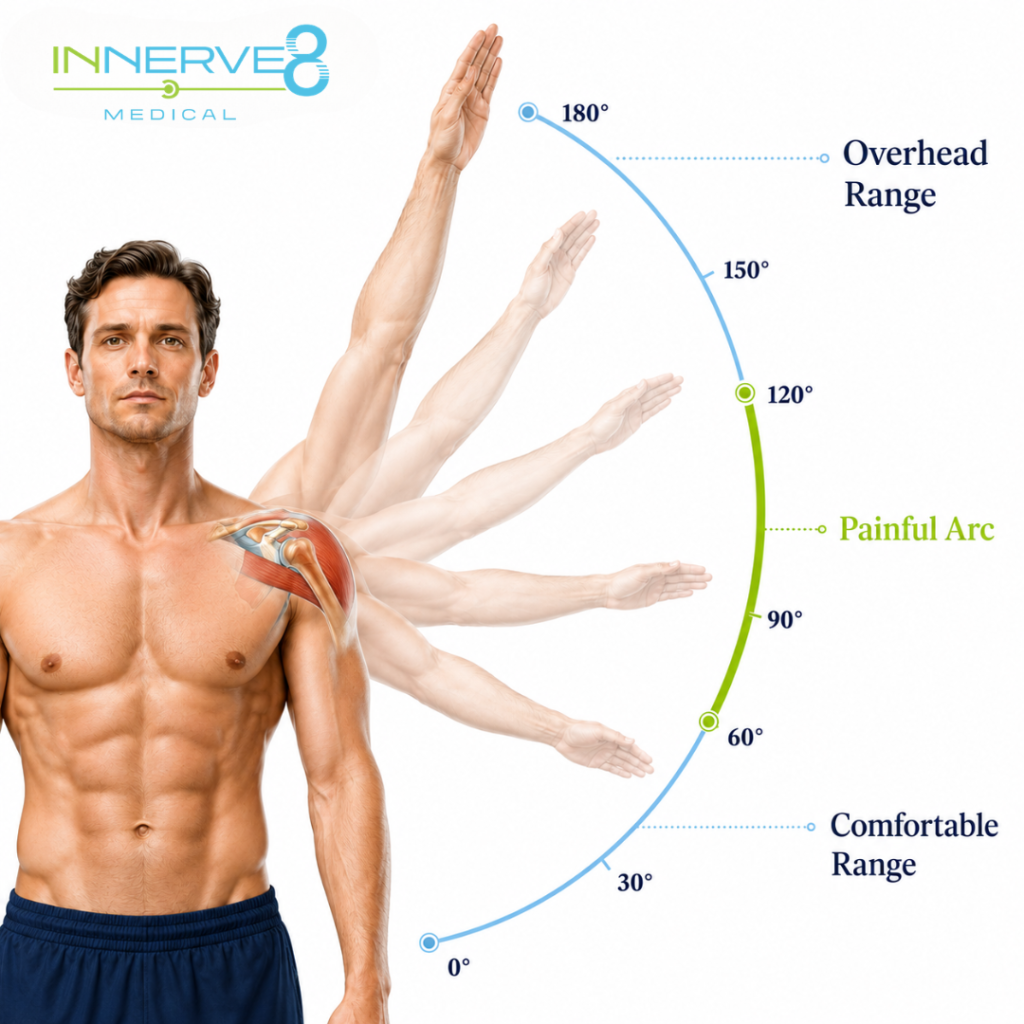 In some people, the bigger issue is stiffness. Frozen shoulder is different from a purely painful shoulder because it involves both pain and a true loss of motion. Over time, the shoulder becomes harder to move, not just more uncomfortable. Mayo Clinic and AAOS both describe frozen shoulder as a condition marked by pain and stiffness that often begins gradually and can make the shoulder very difficult to move over time.
Other people describe more of a pinching, catching, or sharp pain when they try to reach overhead. Some notice that the shoulder feels weak halfway up but not at rest.
Others feel grinding, general restriction, or an aching pain that travels down the arm. The problem is that one symptom — “I can’t lift my arm like I used to” — can come from more than one pattern. That is exactly why generic advice usually falls short.
That is also where many people get stuck. They assume every lifting problem means a tear. Or they assume it is “just inflammation.” Or they rest for a while, feel a little better, return to the same movement pattern, and end up right back where they started.
The better question is not just, “What hurts?”
It is, “Why is the shoulder no longer moving the way it should?”
Why the shoulder is not always the whole story
 This is where Innerve8’s approach becomes different.
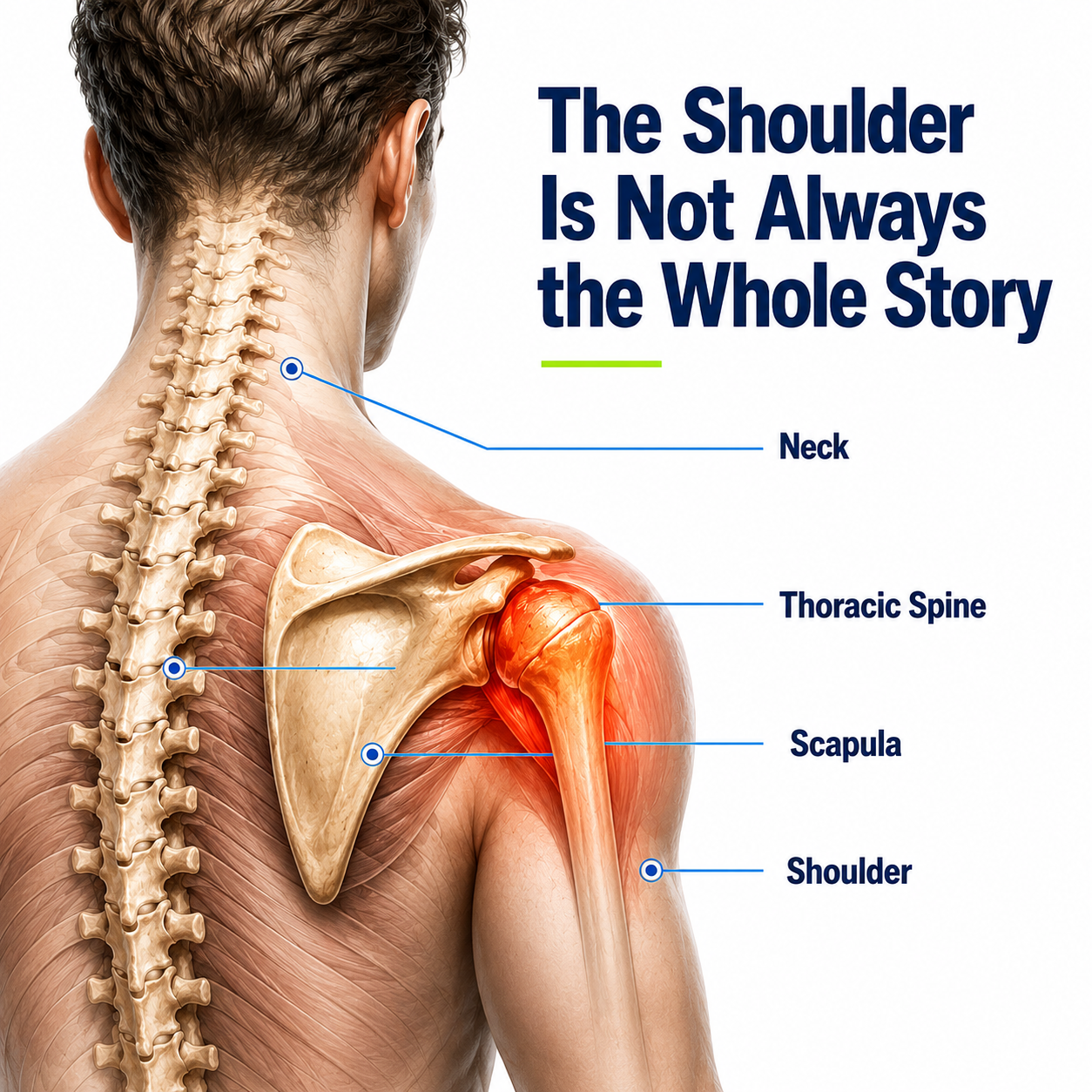
We do not only look at the painful area. We look at how the shoulder is functioning as part of a larger system. That includes range of motion, pain pattern, weakness, posture, scapular mechanics, thoracic mobility, tissue loading, and compensation patterns.
The painful shoulder is not always the whole story. Sometimes the shoulder blade is not moving well. Sometimes the upper back is too stiff. Sometimes the neck is contributing to pain around the shoulder. Sometimes the shoulder is repeatedly taking on more load than it can currently tolerate.
Mayo Clinic’s list of shoulder pain causes includes cervical radiculopathy alongside common shoulder conditions, which is one reason shoulder symptoms should not always be viewed in isolation.
That broader view matters because shoulder problems are often not just about one isolated structure failing out of nowhere. In a lot of people, movement changes build quietly over time. The support muscles stop doing their job efficiently. Overhead mechanics become less controlled. Stiffness develops in nearby areas. The body adapts around the problem until everyday movements no longer feel normal.
That is also why short-term symptom relief and long-term recovery are not always the same thing.
How the right treatment depends on the pattern
At Innerve8 Medical, evaluation comes before treatment.
We look at where motion is limited, whether the restriction seems driven more by pain or by true stiffness, how the shoulder behaves through different ranges, and whether surrounding structures may be contributing to the problem. In some patients, restoring joint motion is part of the answer. In others, the priority is improving control, strength, scapular function, and load tolerance. In some cases, soft tissue restriction is a major driver. In others, irritation or degeneration becomes part of the larger picture.

That is why treatment should match the pattern, not just the symptom label.
Depending on what the evaluation shows, care may include chiropractic adjustments to improve joint motion where appropriate, corrective exercise and sports rehabilitation to improve stability and control, and Graston Therapy when soft tissue restriction is limiting movement. AAOS’s shoulder conditioning guidance notes that strengthening the muscles that support the shoulder helps keep the joint stable and can help relieve pain and prevent further injury.
In selected cases, trigger point injections may also play a role when muscle dysfunction is contributing to the problem. When tissue support and healing potential become part of the larger conversation, regenerative therapies may be considered as part of a non-surgical plan. The goal is not to throw treatments at the problem. The goal is to understand why the shoulder is not functioning well in the first place and build care from there.
That matters for active adults, gym-goers, athletes, and people who are simply trying to get through daily life without constantly modifying how they move. The right next step is not always more rest. It is not always pushing through. And it is not always the same for every shoulder.
When it is time to look deeper
There are also times when shoulder problems should not be brushed off. A sudden inability to raise the arm after trauma, visible deformity, severe swelling, rapidly worsening weakness, or a hot, red joint all deserve prompt medical attention. Mayo Clinic also notes that shoulder pain can sometimes reflect a more urgent issue outside the joint itself, especially if it occurs with chest tightness, sweating, or difficulty breathing.
For everyone else, the main point is simpler. If you cannot lift your arm like you used to, that does not automatically mean one thing. It may reflect rotator cuff-related irritation, weakness, stiffness, impingement, arthritis, or a larger movement pattern that has been building over time. The right next step depends on understanding which pattern is actually present.
That is why guessing is a bad strategy.
If this sounds familiar, call (703) 739-0500 or click here to schedule an evaluation. At Innerve8 Medical, we look at the full pattern behind shoulder pain and movement loss so the next step can be more targeted, more thoughtful, and more sustainable.