


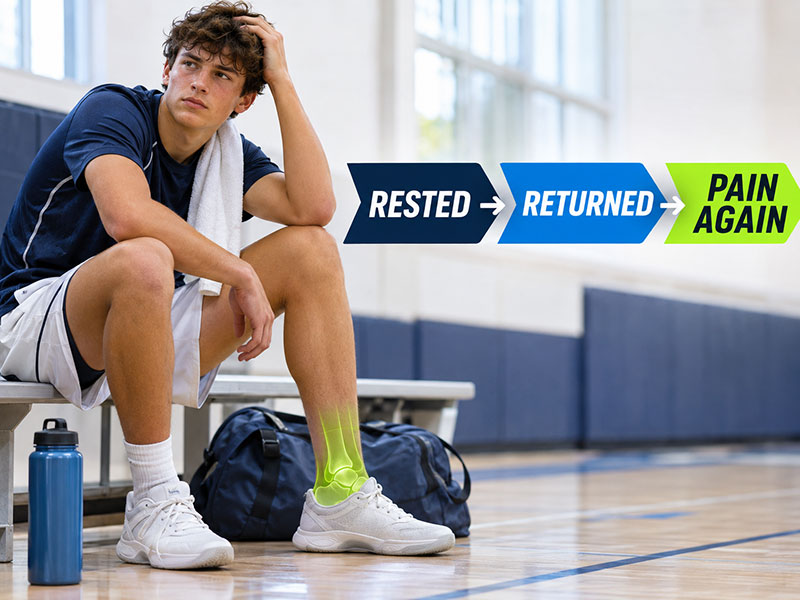
A sore knee after practice, an ankle sprain during a game, or a shoulder that starts bothering an athlete after weeks of throwing or swimming may not seem unusual at first. The athlete rests, the discomfort settles down, and everyone assumes the problem is over. What deserves more attention is when the same pain returns as soon as practices become harder, playing time increases, or the athlete goes back to the movements that caused trouble in the first place.
Recurring sports injuries are common in young athletes, but they should not automatically be dismissed as part of being active. Sometimes the original injury never fully recovered. In other cases, the tissue may be repeatedly overloaded, strength or stability may not have returned, or the athlete may have changed the way they move without realizing it. Young athletes are also still growing, which makes recovery, training volume, and mechanics especially important.
When soreness stops looking like normal recovery
Training soreness is usually predictable. Muscles may feel tired after a difficult practice or workout, but that discomfort tends to improve with rest and does not repeatedly interfere with performance.
An injury that keeps returning often looks different. Pain may show up every time running mileage increases, after several games in a row, or during a particular movement such as throwing, cutting, jumping, or landing. The athlete may start waking up stiff the next morning, losing speed or power, avoiding certain drills, or subtly changing technique to protect the painful area.
Parents may notice these changes before the athlete says anything. Young athletes are not always eager to report pain, especially when they are worried about missing a game, losing a starting position, or disappointing their team. A limp after practice, reluctance to participate, reduced performance, or a sudden change in mechanics can be just as important as hearing, “It hurts.”
Sports medicine guidance from major medical centers consistently points to persistent pain, reduced function, worsening symptoms with activity, and longer recovery after training as reasons to look more closely rather than simply continuing to push through.
Why overuse injuries are so common in student athletes
Many young athletes now train almost year-round. A school season may overlap with club sports, private coaching, travel teams, camps, tournaments, or offseason conditioning. That can leave very little true recovery time.
Training itself is not the problem. The issue is whether the body has enough time and capacity to recover from the amount of stress being placed on it.
Different sports create different demands. Pitchers repeatedly load the shoulder and elbow. Volleyball players jump and hit overhead again and again. Runners load the hips, knees, ankles, and feet thousands of times over the course of a season. Soccer and basketball athletes accelerate, decelerate, cut, land, and change direction constantly.
Problems can develop when that workload starts to exceed what the athlete can currently tolerate.
This is why a few days of rest may make an athlete feel better without fully resolving the issue. If they return to the same workload with the same weakness, mobility restriction, instability, or movement pattern, the same tissue can end up under the same stress again.
The place that hurts is not always the only thing that needs attention
An ankle sprain is a good example. Once the swelling and pain improve, an athlete may feel ready to play again. But if ankle mobility, balance, strength, or stability have not returned, cutting and landing may still be altered. That can contribute to another sprain or begin changing how the knee and hip are being loaded.
 Knee pain can follow a similar pattern. The knee may be where the athlete feels the symptoms, but hip strength, ankle mobility, foot mechanics, landing control, previous injuries, and training volume can all influence what happens at the knee.
Shoulder pain in a swimmer, pitcher, quarterback, or volleyball player may involve the shoulder itself, but upper-back mobility, scapular control, repetitive workload, and muscle balance can affect how that shoulder is functioning.
That is why an evaluation should involve more than identifying the painful spot. At Innerve8 Medical, we look at how the athlete moves, what tissue appears to be irritated, whether strength or stability has been lost, how nearby joints are contributing, and what demands the sport is placing on that area.
Feeling better and being ready to play are not the same thing
Pain often improves before athletic capacity fully returns.
A player may be able to walk comfortably but still not be ready to sprint, cut, and decelerate. A shoulder may feel fine during normal daily activity but still become painful after repeated throwing. An athlete may perform a few pain-free squats in the clinic but struggle once jumping, landing, and fatigue are added back in.
That is why return to sport should not be based on pain alone. Strength, motion, balance, control, confidence, and the ability to perform sport-specific movements all matter.
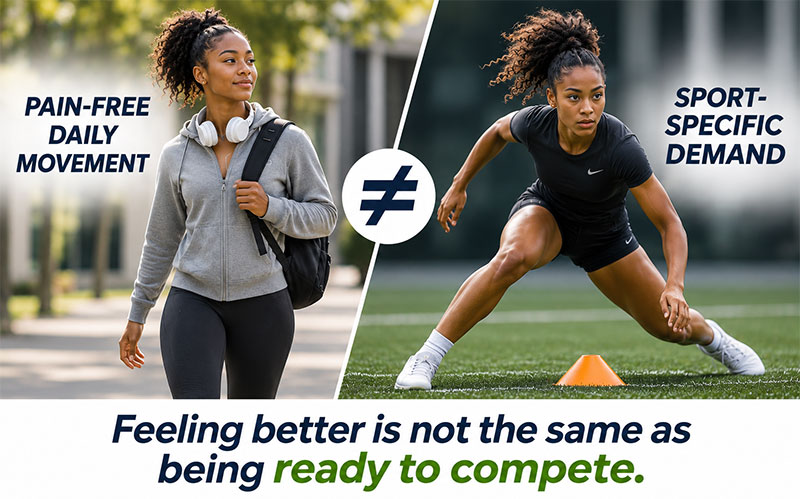
The progression back to practice matters too. Going directly from several days of rest to full competition can create a sharp jump in workload. In many cases, the safer approach is to rebuild tolerance gradually and see how the athlete responds as intensity increases.
Treatment should match the problem
Recurring sports injuries do not all need the same treatment.
A tendon that has become chronically irritated may need a different plan than an unstable ankle, a mobility restriction, or a strength deficit. One athlete may mainly need rehabilitation and a better progression back to training. Another may need treatment directed at an irritated joint or soft tissue while strength and mechanics are being rebuilt.
At Innerve8 Medical, care may include corrective exercise, sports rehabilitation, mobility work, Graston Therapy, chiropractic care, StemWave® acoustic wave therapy, or other non-surgical options when appropriate. In selected older adolescents or young adults with specific musculoskeletal conditions, regenerative treatments may also be considered.
The treatment plan should come from what the evaluation shows, not simply from the location of pain.
When parents should consider having the injury evaluated
Not every sore muscle needs a medical appointment. Recurring pain is different, especially when it begins changing the way an athlete performs or moves.
Pain that returns with activity, swelling or stiffness that keeps coming back, reduced range of motion, limping, weakness, longer recovery after practices, changes in throwing or running mechanics, or avoidance of movements that used to feel normal are all reasonable reasons to have the athlete evaluated.
Catching those patterns earlier can make it easier to address the factors contributing to them before they become a longer interruption to the season.
Getting back to sport should mean being ready for sport
Student athletes often feel pressure to return quickly. There is another practice tomorrow, another tournament this weekend, and only so many games in a season. That pressure is understandable, but returning before the body is ready can start the same cycle again.
A better return means the athlete can tolerate the demands of the sport again with enough strength, mobility, stability, and confidence to perform without constantly protecting the injured area.
If your student athlete has an injury that keeps returning, pain that is affecting performance, or difficulty getting fully back to practice or competition, call (703) 739-0500 or click here to schedule an evaluation with Innerve8 Medical.
We will look at the painful area, how the athlete is moving, and what may be keeping the problem from fully settling down.