

When pain has been around for months—or years—the goal can become very simple:
Make it stop.
That is understandable. Pain can interfere with sleep, exercise, work, travel, and even basic daily movement. In many situations, reducing pain quickly is exactly what a patient needs.

But there is another question worth asking:
What is happening in the tissue that keeps producing the pain in the first place?
That is where regenerative medicine and traditional pain management can begin to take different paths.
They are not opposing fields, and one is not automatically better than the other. Both can be useful. The difference is often in what the treatment is trying to accomplish, what tissue is being targeted, and how that treatment fits into the patient’s larger plan.
Pain Management Has an Important Job
Pain management is a broad medical field.
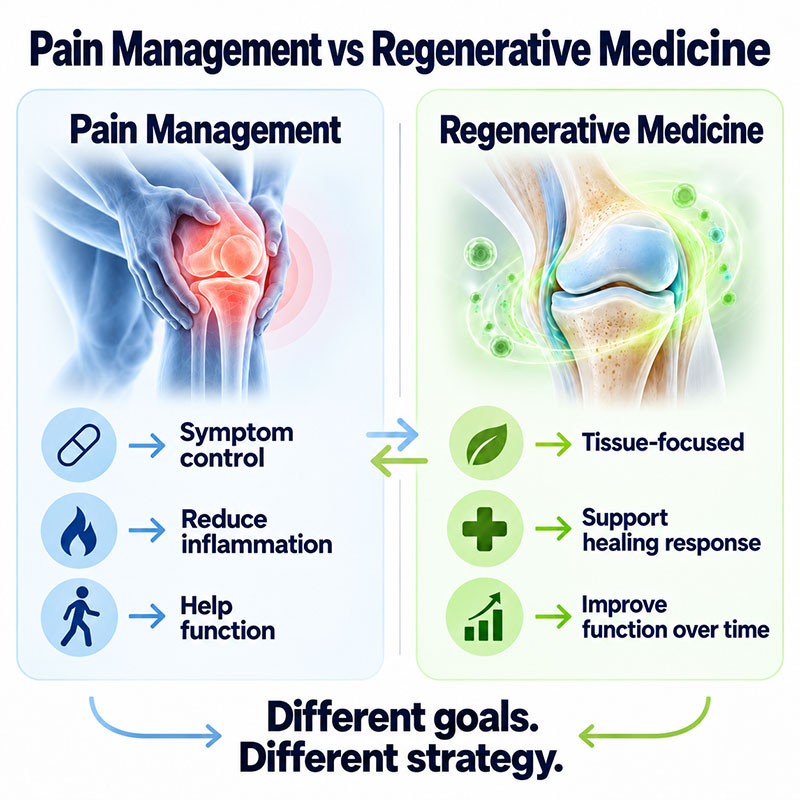
Depending on the condition, treatment may include medications, steroid injections, nerve blocks, radiofrequency procedures, rehabilitation, exercise, or other interventions designed to reduce pain and improve daily function.
 For some patients, that is exactly what is needed.
Severe pain may need to be controlled before someone can sleep normally, return to rehabilitation, or simply get through the day more comfortably. In other cases, an injection or diagnostic procedure may help clarify where symptoms are coming from.
But controlling pain and changing the condition of the involved tissue are not always the same thing.
Take a painful knee. A corticosteroid injection may reduce inflammation and provide meaningful relief. That can be valuable. But if the knee is also dealing with degeneration, weakness, instability, altered mechanics, or excessive load from the way the patient moves, the injection has not necessarily changed those factors.
The same is true for a painful shoulder, hip, tendon, or ligament. Pain relief matters.
But if the problem keeps returning, symptom control may be only one part of the conversation.
Regenerative Medicine Starts With a Different Question
Regenerative medicine looks more closely at whether the body’s own biological processes can be used to support healing, repair signaling, or improved function in selected tissues.
One of the most commonly used examples in musculoskeletal care is platelet-rich plasma, or PRP.
PRP is prepared from a patient’s own blood. The platelet-rich portion is concentrated and introduced into a targeted area. Platelets contain signaling proteins and growth factors involved in the body’s normal healing response.
That does not mean PRP can simply rebuild a damaged joint or reliably regrow lost cartilage.
Those kinds of claims go beyond what current evidence supports.
A more realistic way to think about regenerative care is that it may help influence the biological environment of an injured or degenerative tissue and support a healing response in the right patient.
That distinction matters.
Regenerative medicine should not be sold as magic. It should be used selectively, with a clear understanding of what tissue is being treated and what a realistic outcome looks like.
The Diagnosis Comes Before the Injection
This is where the philosophy at Innerve8 Medical becomes important.
A patient may come in saying, “My knee hurts.”
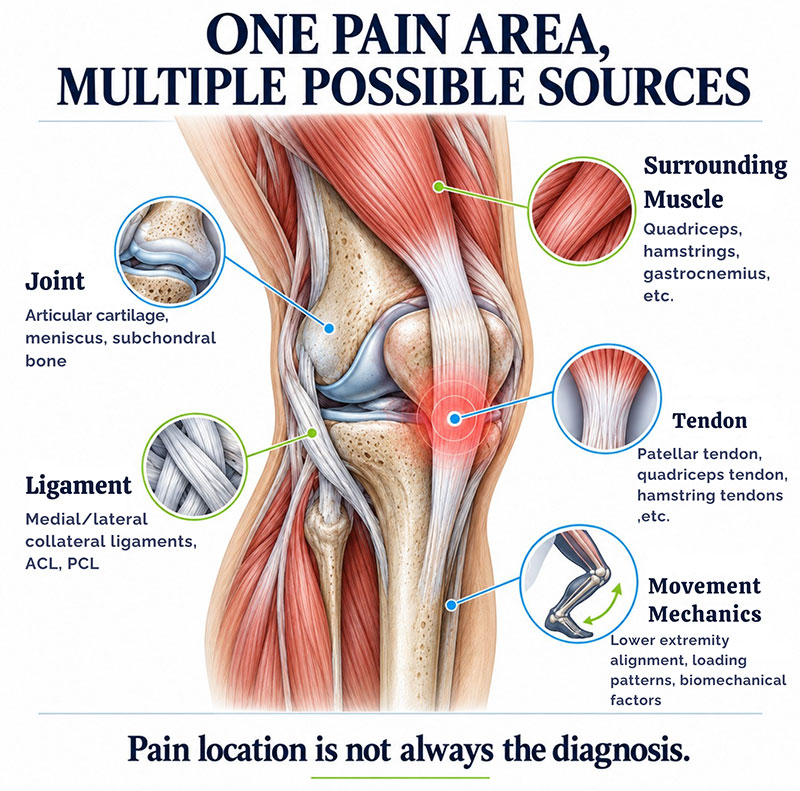
But knee pain is not a diagnosis.
The discomfort could involve cartilage, a tendon, a ligament, the meniscus, surrounding muscle, joint mechanics, or several factors at once.
The same applies to shoulder pain, hip pain, or chronic tendon problems.
Even imaging does not always tell the whole story. An X-ray or MRI may show degeneration, but that does not automatically tell us which structure is creating the symptoms or how much that finding is contributing to the patient’s pain.
Before deciding on PRP, prolotherapy, StemWave®, rehabilitation, chiropractic care, or another intervention, the first question should be:
What are we actually treating? That means looking beyond the pain score.
Range of motion, strength, stability, posture, gait, tissue loading, previous injuries, imaging, and the way neighboring joints are moving can all influence the treatment plan.
A sophisticated therapy used on the wrong target is still the wrong treatment.
Regenerative Care Is Usually More Than an Injection
This is also why we do not think of regenerative medicine as simply “getting PRP.”
An injection can address one part of the problem. It cannot automatically correct the way a joint or tissue is being loaded every day.
If a knee continues to absorb abnormal stress because of poor hip control, limited ankle mobility, or weakness, that mechanical pattern may still be present after the injection.
If a shoulder tendon is treated while the patient still has limited upper-back mobility, poor scapular control, and the same repetitive movement pattern that contributed to the irritation, the tissue may continue to be overloaded.
That is where an integrated medical approach becomes useful.
Depending on the patient, treatment may include regenerative therapies, StemWave® acoustic wave therapy, corrective exercise, sports rehabilitation, mobility work, Graston Therapy, trigger point treatment, chiropractic care, or another appropriate intervention.
Chiropractic is one of those tools. It may be helpful when joint motion, mechanics, or mobility are part of the problem. But it is not the entire treatment philosophy.
The same is true of PRP, StemWave, or any other technology.
The tool should follow the diagnosis—not define it.
So Which Approach Is Better?
That is probably the wrong question.
Some patients primarily need pain control. Some need rehabilitation. Some may be appropriate candidates for regenerative treatment. Some need surgery. And many need a combination of approaches at different stages of care.
The more useful question is whether treatment is being chosen simply because an area hurts—or because the clinician understands what structure is involved, what the treatment goal is, and how that intervention fits into the patient’s overall function.
That is a much more realistic way to look at regenerative medicine.
It is not a replacement for every other form of care.
It is one part of a broader musculoskeletal treatment spectrum, and it works best when the patient is properly selected and the treatment is matched to the actual problem.
Treat the Patient, Not Just the Pain
Pain relief matters, but when the same problem keeps returning, the conversation needs to go beyond simply asking how to make it hurt less. We also want to understand what tissue is involved, how advanced the problem is, how the joint is moving, what may be placing repeated stress on the area, and whether the tissue is still likely to respond to conservative or regenerative treatment. From there, the goal is to choose the combination of treatments that gives the patient the most reasonable path forward.
That is the approach we take at Innerve8 Medical.
If joint, tendon, or musculoskeletal pain is interfering with your movement and you want to understand whether regenerative care may be appropriate, call (703) 739-0500 or click here to schedule an evaluation with Innerve8 Medical.
The goal is not simply to choose a treatment. It is to understand the problem well enough to choose the right one.
Sources
Cleveland Clinic — Pain Management
Mayo Clinic — Platelet-Rich Plasma and Orthobiologics
Mayo Clinic News Network — Regenerative Medicine and Musculoskeletal Care